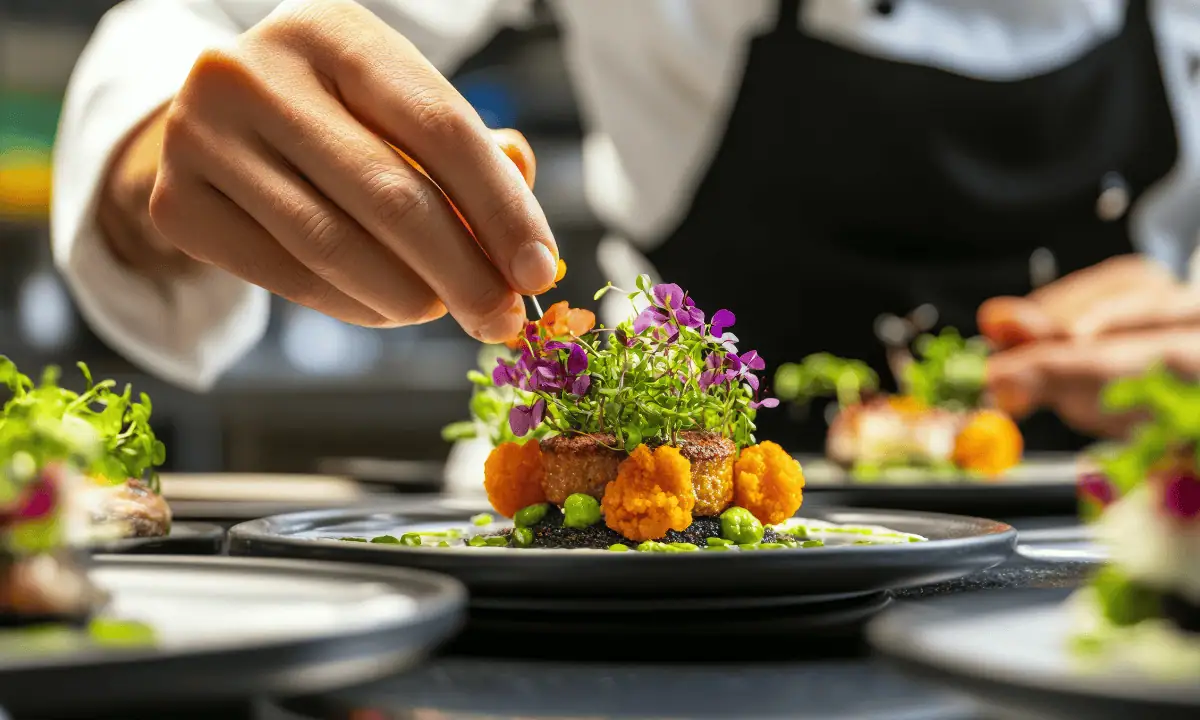
Walk into one of Dubai’s top restaurants today, and you’ll notice something small but striking on the plate. A single purple pansy balancing on a piece of salmon. A cluster of micro basil leaves crowning a dessert. A bright nasturtium adding colour to an otherwise simple salad.
These delicate additions aren’t decoration for decoration’s sake. They represent a new chapter in the UAE’s culinary evolution — one that blends agriculture, aesthetics, and sustainability in equal measure.
A Growing Appetite for Edible Beauty
Edible flowers and microgreens have become the signature of contemporary fine dining — vibrant, aromatic, and packed with flavour. Once limited to boutique suppliers in Europe or Asia, they are now being cultivated right here in the Emirates, thanks to advances in indoor and container-based farming.
Chefs love them because they transform a dish’s visual appeal; nutritionists praise them for their high concentration of antioxidants, vitamins, and minerals. For diners, they represent freshness — a symbol of craftsmanship and locality.
And for farmers like us at DuneFarms, they represent one of the highest-value crops per square metre that can be produced sustainably in the UAE climate.
A Perfect Match for Vertical Farming
Growing edible flowers or microgreens outdoors in the region’s heat and humidity would be nearly impossible without heavy irrigation and pesticide use. But in a controlled environment, these delicate crops thrive.
Container and vertical farming systems allow for precise regulation of temperature, humidity, and light — exactly what sensitive plants need.
Our container units, for instance, provide full-spectrum LED lighting that mimics the natural sun while allowing us to fine-tune colour wavelengths to enhance pigment, aroma, and nutrient density.
The result: consistent quality, year-round supply, and zero pesticide residues.
This technological edge is what makes the UAE one of the few places where premium, locally grown edible flowers can meet the standards of top-tier restaurants and hotels.
From Europe to Emirates: A Global Trend Finds a Local Home
Globally, the demand for edible flowers and microgreens has surged, driven by both the fine dining scene and the booming health and wellness market. But what’s happening in the UAE is distinct.
Here, food innovation has always gone hand-in-hand with sustainability. As the Abu Dhabi Agriculture and Food Safety Authority (ADAFSA) continues to promote advanced agri-tech solutions for high-value crops, chefs and hoteliers are increasingly sourcing locally to reduce imports and carbon footprint .
Vertical farms across Abu Dhabi and Dubai — including projects in Masdar City, Sustainable City, and Yas Island — are already supplying restaurants and retailers with UAE-grown basil, mustard greens, shiso, and edible flowers .
DuneFarms’ contribution builds on this same philosophy: freshness measured not in miles but in minutes.
Why Chefs Are Turning to Local Producers
The culinary sector in the UAE is one of the most competitive in the world. Restaurants constantly look for ways to distinguish their offerings, and sourcing local, pesticide-free ingredients is becoming part of that identity.
By partnering directly with local indoor farms, chefs gain access to:
- Consistent quality: Year-round production unaffected by weather or shipping delays.
- Customisation: Ability to request specific varieties or harvest stages (for example, younger micro herbs for stronger flavour).
- Sustainability: Shorter supply chains and drastically reduced food miles.
- Storytelling: The ability to tell diners that their garnish was grown just a few kilometres away — an authentic, local narrative.
As one Dubai chef recently told us during a farm visit: “Our guests love knowing their flowers were grown in the same city as their meal. It adds something genuine to the experience.”
From Plate to Brand: Edible Identity
For many restaurants and hotels, sourcing locally has become a matter of brand philosophy. The concept of “farm-to-table” — once a marketing slogan — is evolving into a tangible standard of quality and responsibility.
Hotels like St. Regis Saadiyat, JW Marriott Marquis, and Sustainable City’s SEE Institute have already installed or partnered with vertical farms for microgreen and herb production . The logic is simple: it strengthens sustainability credentials while ensuring unmatched freshness.
DuneFarms is building on this momentum by offering hospitality clients fully traceable, tailor-grown crops — from delicate nasturtiums to bold marigolds — all produced within state-of-the-art container farms operating on minimal water and zero pesticides.
A Business Opportunity Rooted in Taste and Technology
While edible flowers may seem niche, they are part of a larger economic story. Globally, the market for microgreens and specialty edible crops is projected to grow by over 10% annually through the end of the decade.
In the UAE, where demand for fine dining and high-end hospitality continues to expand, the opportunity to replace imported premium produce with local, sustainable alternatives is both economic and strategic.
For DuneFarms and other local producers, this means we’re not only contributing to the country’s food security vision but also helping redefine what premium agriculture can look like in the Gulf.
Cultivating the Future of UAE Cuisine
The UAE has always been a crossroads — of cultures, cuisines, and ideas. Today, it’s also becoming a hub for food innovation.
What was once imported luxury is now local craft. Edible flowers and microgreens — grown in the heart of the desert using precision agriculture — represent not just the beauty of food, but the progress of a nation determined to grow sustainably.
At DuneFarms, we see every tray of micro basil, every flowering pansy, and every delicate leaf as proof that local farming in the UAE isn’t a challenge — it’s an opportunity waiting to bloom.